Articulated 3D Printable Heart Model: A Guide to Flexi Heart
In the rapidly evolving world of additive manufacturing, the focus has shifted from merely producing functional prototypes to creating objects that engage the senses and evoke emotion. Among the most popular categories in this space are interactive desktop toys and kinetic sculptures. One standout example that has captured the imagination of hobbyists and professionals alike is the Articulated 3D Printable Heart Model, often referred to by its specific design name, Flexi Heart. This model represents a perfect intersection of engineering precision and aesthetic charm, offering a tangible way to explore the capabilities of modern 3D printing technology.
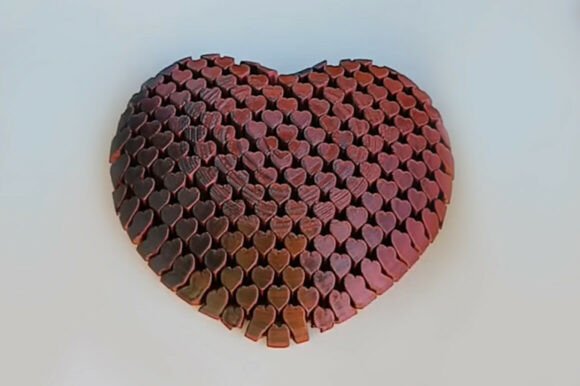
Unlike traditional rigid models that require assembly or glue, the Flexi Heart is designed as a single, continuous piece. It features a complex internal structure that allows it to bend, twist, and articulate smoothly without any moving parts being separate. This "print-in-place" characteristic not only simplifies the printing process but also ensures structural integrity, making it a durable and satisfying object to handle. For those seeking to add a touch of whimsy to their workspace or looking for a unique gift, understanding the nuances of this model is essential.
The Design Philosophy Behind Flexi Heart
The core appeal of the Articulated 3D Printable Heart Model lies in its clever mechanical design. At first glance, it appears to be a solid heart shape. However, upon closer inspection, one can see a series of interlocking segments or hinges that allow for significant flexibility. This design leverages the layer-by-layer nature of Fused Deposition Modeling (FDM) printing, where small gaps between printed sections act as natural joints.
This approach eliminates the need for post-print assembly, which can be tedious and often results in weak points at connection sites. Instead, the entire model is printed as one unit. The smooth, flexible movement is achieved through precise spacing calculations in the digital file. If the spacing is too tight, the parts will fuse together during printing; if too loose, the articulation will feel sloppy. The success of the Flexi Heart demonstrates how digital modeling software can simulate physical mechanics, allowing creators to design objects that behave like real-world mechanisms before they are ever materialized.
Key Features and Characteristics
- Fully Articulated Structure: The model bends and flexes along multiple axes, providing a tactile experience that is both soothing and entertaining.
- No Supports Required: The geometry is optimized so that overhangs do not necessitate support structures. This saves filament and reduces post-processing time.
- Smooth Tactile Feel: When printed correctly, the joints move fluidly, avoiding the gritty or stiff sensation common in poorly tuned prints.
- Compact Form Factor: Its size makes it an ideal desk accessory that does not clutter the workspace but remains visible and accessible.
Why Choose PLA or PETG?
Selecting the right material is critical when printing an Articulated 3D Printable Heart Model. While many filaments can be used, PLA (Polylactic Acid) and PETG (Polyethylene Terephthalate Glycol) are the most recommended choices due to their distinct properties.
PLA is the go-to material for beginners and experienced users alike because of its ease of use and dimensional accuracy. It prints at relatively low temperatures and provides a crisp finish. However, PLA is somewhat brittle and can snap if bent beyond its limit repeatedly. For a heart model, this means it offers good initial flexibility but may eventually fatigue if subjected to extreme stress.
PETG, on the other hand, offers superior flexibility and durability. It is less prone to breaking under repeated bending, making it an excellent choice for a toy intended for frequent handling. PETG also has better heat resistance, meaning the heart won’t deform if left near a warm monitor or in a hot car. The trade-off with PETG is that it can string more easily than PLA, requiring careful tuning of retraction settings to maintain the clean look of the articulated joints.
Optimizing Print Settings for Success
To achieve the best results with your Articulated 3D Printable Heart Model, specific printer settings must be adhered to. These settings ensure that the joints remain open enough to move but strong enough to hold their shape.
- Nozzle Size: A standard 0.4 mm nozzle is recommended. This size offers a good balance between detail and print speed.
- Layer Height: Setting the layer height to 0.16 mm provides high quality without significantly extending print times. Thinner layers can improve surface finish but may increase the risk of joints fusing if cooling is insufficient.
- Temperature Control: Maintaining a nozzle temperature of 230 °C for the first layer and subsequent passes helps ensure proper adhesion between layers while preventing excessive oozing that could clog the joints. The bed temperature should be set to 70 °C, preferably on a textured PEI plate for easy removal.
- Print Speed: Slowing down the outer walls to 60 mm/s allows for better control and precision. Travel speed can be increased to 200 mm/s to minimize stringing.
- Infill Pattern: Using a gyroid infill at 5% density provides sufficient structural strength while keeping the print lightweight and fast. The gyroid pattern distributes stress evenly, which is beneficial for a flexible object.
- Cooling: Active cooling is vital. Setting the fan to 100% after the first few layers ensures that each new layer cools quickly before the next is deposited. This prevents the plastic from becoming too soft, which could cause the joints to weld together.
- Retraction: Enabling retraction with a distance of 0.8 mm at 30 mm/s helps prevent unwanted blobs of filament from forming inside the hinge areas.
Real-World Applications and Use Cases
The versatility of the Articulated 3D Printable Heart Model extends beyond simple decoration. Its unique properties make it suitable for various scenarios:
Desk Accessories: For office workers, the Flexi Heart serves as a fidget tool. The repetitive motion of bending the heart can help reduce stress and improve focus during long work sessions. Its compact size ensures it fits neatly on a desk alongside monitors and keyboards.
Educational Demonstrations: Teachers and students can use the model to demonstrate concepts in physics and engineering, such as elasticity, joint mechanics, and material science. It provides a tangible example of how digital designs translate into physical objects with specific functional properties.
Gift Giving: In the realm of personal gifts, the Flexi Heart stands out. Whether for Valentine’s Day, anniversaries, or weddings, it offers a personalized touch that store-bought items lack. The effort involved in selecting and printing the model adds sentimental value, making it a memorable keepsake.
Considerations and Limitations
While the Articulated 3D Printable Heart Model is impressive, there are practical considerations to keep in mind. First, print failure is a possibility if settings are not calibrated correctly. Joints may fuse if the temperature is too high or cooling is inadequate. Second, the model is delicate in the sense that extreme force can break the thin connecting links. It is designed for gentle manipulation, not for heavy-duty play.
Additionally, the aesthetic finish depends heavily on the printer’s calibration. Users with printers that struggle with consistent extrusion may notice minor imperfections in the joints. Post-processing, such as light sanding or cleaning with isopropyl alcohol, can enhance the final appearance but should be done carefully to avoid damaging the flexible parts.
Evaluating Suitability for Your Needs
Before embarking on printing the Flexi Heart, consider your current skill level and equipment. If you are new to 3D printing, this project serves as an excellent intermediate challenge. It teaches important skills like slicing parameter adjustment, material selection, and troubleshooting print failures. For seasoned enthusiasts, it offers an opportunity to experiment with different materials and fine-tune their machines for optimal performance.
Business owners and content creators can also benefit from this model. It can be used as a prop for social media content, showcasing the capabilities of a 3D printing service or studio. The visually appealing nature of the articulated heart attracts attention and demonstrates the potential for creating engaging, interactive products.
Conclusion
The Articulated 3D Printable Heart Model, or Flexi Heart, is more than just a cute decoration. It is a testament to the creativity and technical prowess possible with modern 3D printing. By combining thoughtful design with precise printing parameters, users can create a functional, beautiful object that brings joy and utility to their daily lives. Whether used as a stress-relief tool, an educational aid, or a heartfelt gift, the Flexi Heart exemplifies the power of additive manufacturing to transform digital ideas into meaningful physical experiences. As you prepare to print your own version, remember that patience and attention to detail are key to unlocking the full potential of this remarkable model.