Honeybee Honeycomb Pen Pot STL 3d Print: A Practical Evaluation for 3D Printing Enthusiasts
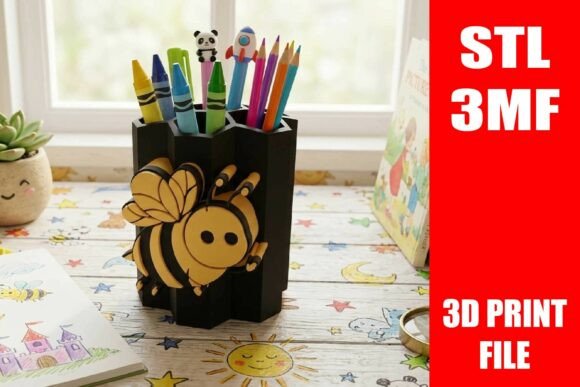
The intersection of functional design and aesthetic appeal is where many modern 3D printing projects thrive. Among the myriad of desktop accessories available in digital repositories, the Honeybee Honeycomb Pen Pot STL 3d Print stands out as a compelling option for hobbyists and professionals alike. This digital asset offers a unique blend of organic geometry and utility, designed specifically to streamline the workflow of users who value both organization and visual interest on their desks.
When evaluating digital downloads for 3D printing, it is crucial to look beyond the visual renderings and assess the technical integrity of the file. The Honeybee Honeycomb Pen Pot is not merely a decorative object; it is an engineered solution for storing writing instruments, small tools, or desk essentials. By examining its design philosophy, technical specifications, and practical application, potential buyers can determine whether this specific STL file aligns with their printing capabilities and organizational needs.
Understanding the Design Philosophy
At its core, the Honeybee Honeycomb Pen Pot leverages the structural efficiency of hexagonal patterns. In nature, honeycombs are renowned for their strength-to-weight ratio and material efficiency. Translating this into a pen pot creates a structure that is visually striking while maintaining robustness. The interlocking hexagonal cells provide a textured surface that adds depth and character, moving away from the monotony of standard cylindrical or square containers.
This design choice serves multiple purposes. Aesthetically, the geometric pattern catches light and shadow in dynamic ways, making the object a focal point on any workspace. Functionally, the varying depths of the hexagonal cells can offer different levels of storage security. Deeper cells can hold taller items like markers or paintbrushes securely, while shallower sections might be ideal for holding loose paperclips, erasers, or USB drives. The result is a versatile container that adapts to the user’s specific clutter without requiring complex assembly.
Technical Integrity and File Quality
For any 3D printing project, the quality of the source file is paramount. Poorly generated meshes often lead to print failures, excessive support material, or weak structural points. The Honeybee Honeycomb Pen Pot STL 3d Print addresses these common pain points by prioritizing clean, high-quality geometry. Designed using professional 3D software, the mesh is optimized to minimize errors such as non-manifold edges or inverted normals, which are frequent causes of slicing software confusion.
Error-free geometry ensures that the file slices smoothly across various platforms, reducing the time spent troubleshooting before the first layer even hits the build plate. This level of preparation is particularly beneficial for users who may be less experienced with mesh repair tools. It allows the printer to focus on execution rather than correction, leading to more consistent results and a higher success rate on the first attempt.
Furthermore, the file has been rigorously tested using PLA filament on a Bambu Lab A1 Mini. This testing phase is significant because it validates the design against real-world printing conditions. The Bambu Lab A1 Mini is known for its speed and precision, but it also demands files that are well-optimized for rapid printing. If a model prints cleanly and successfully on a fast, automated machine, it is highly likely to perform well on other FDM printers as well. This validation provides confidence to the buyer that the design is not just theoretical but practically viable.
Benefits of Choosing This Digital Asset
Selecting the Honeybee Honeycomb Pen Pot STL 3d Print offers several distinct advantages for the 3D printing community. First, the ease of printing cannot be overstated. The design minimizes the need for extensive supports, which reduces post-processing time and material waste. Supports can often mar the surface finish of delicate geometric features, so a design that avoids them preserves the intricate details of the honeycomb pattern.
- Time Efficiency: With pre-tested geometry and minimal support requirements, the total print time is reduced, allowing users to produce multiple units or other projects more quickly.
- Material Savings: By avoiding unnecessary supports and optimizing wall thickness, the design helps conserve filament, which is a cost-effective benefit for frequent printers.
- Aesthetic Versatility: The honeycomb motif complements a wide range of interior styles, from industrial lofts to minimalist home offices, making it a flexible addition to any environment.
- Immediate Availability: As a digital download, there is no shipping wait time. Users can begin printing immediately after purchase, satisfying the desire for instant gratification common in maker culture.
Considerations and Tradeoffs
While the benefits are clear, a balanced evaluation requires acknowledging potential tradeoffs. The primary consideration is the complexity of the internal geometry. While the honeycomb pattern is beautiful, it can sometimes trap dust or small debris if the cells are not fully enclosed at the bottom. Users should inspect the specific STL file to ensure the base design meets their cleaning preferences. Some variations may have open bottoms for drainage or ease of printing, while others may be fully sealed.
Additionally, the scale of the pen pot must be considered. Although the file is tested on a Bambu Lab A1 Mini, users with smaller printers may find that the dimensions exceed their build volume. It is essential to check the model’s bounding box in slicing software before purchasing. Similarly, users printing with flexible filaments like TPU may encounter challenges with the overhangs inherent in honeycomb structures, whereas rigid materials like PLA or PETG are ideal for this design.
Another factor is the lack of physical interaction prior to purchase. Since this is a DIGITAL DOWNLOAD, buyers rely entirely on screenshots and descriptions. While the professional testing mentioned above mitigates some risk, it does not replace the tactile experience of holding a physical prototype. However, the low cost of digital assets compared to physical goods makes this a relatively low-risk investment.
Who Is This For?
The Honeybee Honeycomb Pen Pot STL 3d Print is best suited for individuals who appreciate geometric aesthetics and want a reliable, ready-to-print solution. It is an excellent fit for educators, office workers, and artists who need organized storage that doubles as decor. It is also ideal for 3D printing enthusiasts looking to test their machines’ ability to handle intricate details without supports.
Conversely, those seeking ultra-simple, utilitarian objects with no decorative elements might find this design overly complex. Additionally, users who prefer to design every aspect of their models from scratch may opt to modify existing open-source files rather than downloading a finished product. For these groups, simpler alternatives or customizable CAD files might be more appropriate.
Conclusion
In summary, the Honeybee Honeycomb Pen Pot STL 3d Print represents a thoughtful convergence of form and function. Its error-free geometry, validated by testing on popular hardware, offers a reliable path to a successful print. By understanding its strengths—such as ease of printing and aesthetic appeal—and its limitations, such as potential dust trapping and scale constraints, users can make an informed decision. For anyone looking to add a touch of organized elegance to their workspace, this digital asset provides a practical and visually pleasing solution.