Valentine Rose I Love You 3D Model for Easy 3D Printing
The landscape of gift-giving has undergone a quiet but significant transformation in recent years. For decades, the options for expressing affection on Valentine’s Day remained largely static: flowers that wilt within days, chocolates that disappear quickly, or generic jewelry that lacks personal resonance. However, the rise of accessible digital fabrication and consumer-grade 3D printing has introduced a new category of meaningful gifts—one that blends technology with tangible sentiment. At the forefront of this shift is the Valentine Rose I Love You 3D Model for Easy 3D Printing, a design that redefines how we approach romantic gestures through the lens of modern manufacturing.
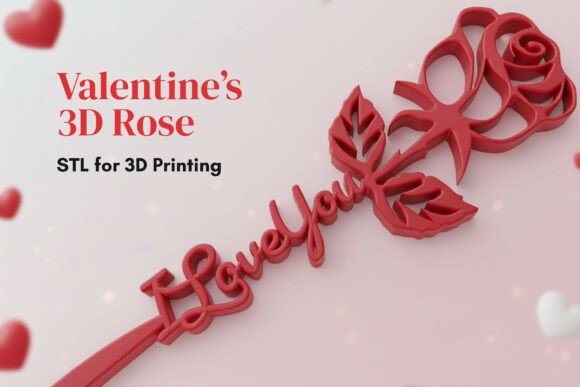
This specific model is not merely a novelty item; it represents a convergence of aesthetic elegance and functional engineering. By integrating the phrase “I Love You” directly into the stem of a rose, the design creates a seamless union of form and message. It appeals to a broad demographic, from hobbyists looking to test their printers’ capabilities to professionals seeking unique, personalized corporate gifts. The relevance of this model lies in its ability to solve a common problem: the desire for a lasting token of love that does not require complex assembly or specialized skills to produce.
The Evolution of Personalized Digital Gifts
To understand the impact of the Valentine Rose I Love You 3D Model, one must look at the broader trend toward personalized digital assets. In the past, customization required expensive tooling or artisanal craftsmanship. Today, STL files allow anyone with a 3D printer to create bespoke items. This democratization of manufacturing has changed user expectations. Consumers no longer settle for mass-produced uniformity; they seek items that reflect individual taste and effort.
The market for 3D printable models has matured significantly. Early iterations of 3D printed objects were often rough, requiring extensive post-processing and support structures that complicated the workflow. Modern designs, however, are optimized for the realities of FDM (Fused Deposition Modeling) and resin printing. The Valentine Rose exemplifies this evolution. It is engineered to print as a single solid piece, eliminating the frustration of assembling multiple parts. This "print-and-go" philosophy aligns with the busy lifestyles of adults aged 20–50, who value efficiency without sacrificing quality.
Furthermore, the integration of text into organic shapes was once a technical challenge prone to failure. Fine details often got lost or became fragile. The success of this model demonstrates improved slicing algorithms and better understanding of structural integrity in 3D modeling software. It shows that digital art can now carry emotional weight just as effectively as traditional sculpture, provided the file is well-constructed.
Design Philosophy: Simplicity Meets Romance
The core appeal of the Valentine Rose I Love You 3D Model for Easy 3D Printing is its balance between romantic symbolism and practical design. A rose is a universal symbol of love, but adding the textual element transforms it from a generic icon into a specific declaration. The placement of the words along the stem ensures readability while maintaining the botanical structure of the flower. This dual-layered communication—visual and textual—creates a richer experience for the recipient.
From a technical standpoint, the model prioritizes smooth surfaces and balanced thickness. These are critical factors for successful printing. Thin walls can lead to warping or breakage, while overly thick sections may cause cooling issues or excessive material usage. By optimizing these dimensions, the designer ensures that the final object is durable enough to serve as a decorative piece or a keepsake. The absence of supports required for printing is another major advantage. Support structures often leave marks on the surface that need sanding or cutting away, detracting from the pristine look of a delicate rose. A support-free design means a cleaner finish right off the build plate, saving time and reducing waste.
This attention to detail reflects a growing awareness among creators and users alike. There is a shift from "can we print it?" to "should we print it, and will it look good?" The Valentine Rose answers affirmatively to both questions. It serves as an excellent example of how thoughtful design can enhance the utility of 3D printing technology.
Practical Implications for Creators and Hobbyists
For the growing community of 3D printing enthusiasts, this model offers several practical benefits. First, it is an ideal project for testing new filaments or resins. Because the model features varied geometries—from the curved petals to the straight stem—it challenges the printer in multiple ways. Users can observe how different materials handle overhangs, layer adhesion, and fine details. This makes it more than just a gift; it is a diagnostic tool for printer calibration.
- Material Versatility: While red filament is the traditional choice for a rose, the STL format allows for endless customization. Creators can experiment with translucent resins to create a glowing effect, or use gradient filaments to mimic the natural color variations of real petals. This flexibility encourages creativity and experimentation.
- Scalability: The customizable size feature is particularly useful. A small version can be used as a keychain or a desk ornament, while a larger scale version becomes a statement piece for home decor. This adaptability increases the model's utility across different contexts.
- Efficiency: The single-piece construction reduces print time compared to multi-part assemblies. For those running multiple prints simultaneously, this efficiency translates to higher throughput and lower energy consumption.
Moreover, the ease of printing lowers the barrier to entry for beginners. New users often struggle with complex models that fail frequently, leading to frustration and abandoned projects. A reliable, easy-to-print model like the Valentine Rose builds confidence. It provides a quick win, encouraging further exploration of 3D printing techniques.
Business Applications and Professional Use
The relevance of this model extends beyond personal hobbies. Entrepreneurs, marketers, and business owners are increasingly leveraging 3D printing for client engagement and internal culture. In a competitive market, personalized touches can differentiate a brand. Imagine a real estate agent gifting a custom-colored Valentine Rose to a client closing a deal, or a tech company using them as employee appreciation tokens during Valentine’s Week.
The professional implications are significant. Traditional promotional items are often discarded due to their lack of sentimental value. A 3D printed rose, however, carries the weight of thoughtfulness and technological sophistication. It signals that the giver values innovation and personal connection. Additionally, because the file is digital, businesses can store inventory virtually rather than physically. They can produce items on-demand, reducing storage costs and minimizing waste from unsold goods. This just-in-time production model aligns with sustainable business practices, appealing to environmentally conscious consumers.
Educators and freelancers can also benefit. Instructors might use the model to teach principles of geometry, symmetry, and structural design. Freelancers offering design services can showcase their ability to optimize files for manufacturing by presenting this model as a case study. It demonstrates an understanding of both aesthetics and technical constraints.
Customization and Future Trends
As technology advances, the potential for further customization grows. We are moving toward a future where AI-assisted design tools will allow users to modify parameters like petal curvature or text font size with simple sliders. The Valentine Rose I Love You 3D Model is poised to benefit from such innovations. Its open nature invites modification, allowing users to tailor the design to specific cultural or personal preferences.
There is also a growing interest in hybrid materials. Future iterations might incorporate conductive filaments to add LED lighting, or flexible TPU for a softer touch. These enhancements would expand the model’s functionality, turning it from a static decoration into an interactive object. However, even in its current form, the model remains highly relevant because it focuses on the fundamental aspects of good design: clarity, durability, and emotional resonance.
The trend toward "phygital" goods—physical items with digital origins—is accelerating. Consumers are becoming more comfortable buying digital files to create physical products. This shift empowers individuals to take control of their consumption habits. Instead of buying a product made elsewhere, they create it themselves, knowing exactly what materials were used and how it was made. This transparency fosters a deeper connection to the object.
Conclusion: A Timeless Gesture in Modern Form
The Valentine Rose I Love You 3D Model for Easy 3D Printing is more than just a file download; it is a reflection of changing attitudes toward love, labor, and technology. It proves that modern tools can enhance traditional expressions of emotion rather than replace them. By combining the timeless symbol of the rose with the contemporary capability of 3D printing, it offers a fresh perspective on how we celebrate relationships.
Whether you are a seasoned maker looking to refine your settings, a business owner seeking unique branding opportunities, or simply someone wanting to express love in a memorable way, this model provides a versatile solution. Its ease of use, aesthetic appeal, and adaptability make it a standout choice in the crowded field of digital designs. As we continue to integrate technology into our daily lives, models like this remind us that the most important elements—connection, creativity, and care—remain human-centric. In a world of fleeting digital interactions, holding a tangible, beautifully crafted rose stands as a powerful testament to enduring affection.